It was the day for the spring clean at St Oswalds and aware that this may prove challenging for my reduced mobility, I opted to join the ‘polishers’ sitting in the Carlton Room. Arriving too late to take the precious job of polishing the processional cross (and how splendid it is when you get close to it) I searched instead for a meaningful alternative. The powerful smell of Brasso pervaded, and I think for us oldies (the youngsters were busy cleaning in church) it brought back many memories of cleaning the family brassware at home. It was an evocative smell.
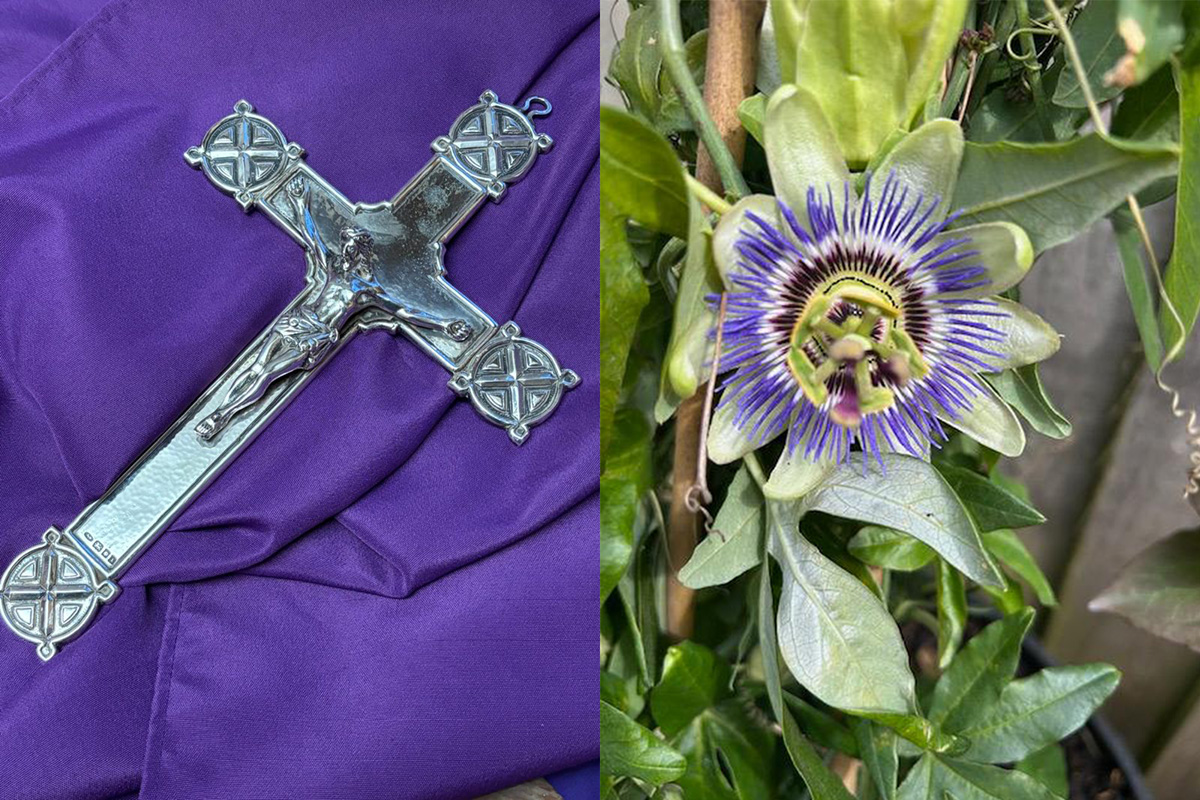
At last, I came across a smallish silver crucifix that, to be honest, I could not recall seeing hanging in church, and I settle down with somewhat inappropriate gusto to give ‘Christ a Buffing.’ Astounded as to how heavy the crucifix was , I laid it carefully on my knee, while sneaking an envious occasional glance at David, polishing away on the glorious tall processional cross. Little did I know how the impact this depiction of Christ’s suffering would subsequently have on me. Brought up on strict Methodist principles, objects of veneration, such as crucifixes, are truly not familiar to me, or (dare I write…) or even in the past, acceptable to my simple Christian faith. But of course God knows best and through my now gently caressing and care for this silver suffering image held close to me, I was able to experience some of the depths of Christ suffering (for us) at Easter time.
I recall two, a decade ago, writing a ‘Monolgue for Mary’, a piece to be re-enacted in our Leicester church on Good Friday by the very talented then vicar’s wife, Marion. It was a very powerful experience to see and feel the agony of Jesus’s mother as he lay in dying before her on the cross. Indeed, Mary shouldered the weight of her love for him, as Jesus bore his cross along the alleyways of Jerusalem.
The wider significance of the Easter story being love and suffering that are indivisible. In modern times, we have hijacked the word ‘passion’ to have a profoundly different meaning, one which has no connection at all with the true meaning of suffering and endurance. The traditional meaning I found arising in the 17th century, with the naming of the passionflower Passiflora, which grew abundantly until recently in my garden. This wonderful flower adorned our garden arbor, surrounding, enfolding and enshrining in love, my suffering dying husband as he sat beneath it, until he died. Shortly after this, in spite of my efforts, the flowers died too . I’m trying to grow them again now so I can point out the names of the flower parts to my grandchildren and the reason for their names. The outer ring represents Christ’s crown of thorns; the ten petals and sepals the apostles who remained faithful to Him; and the inner parts, the nails and wounds of Jesus. As I write this the small passion plant that I recently bought has given me its first purple passion flower in bloom and I have taken a photo of it for you. How sacred and beautiful that is!
Returning to my final polish of this crucifix before me, where this absolutely amazing man called Jesus hung and died . Finally, I caress his feet and feel for his agony of having them nailed to the cross. I have a sore little toe at the moment … how would it feel to have nails hammered through both of your feet? I feel somewhat ashamed to complain. Mary was watching all this and enduring the suffering of her son.
To me, family love in all its complexity, has shaped me. The passion, using the word in its new context, I feel for family nearly every day, and having grandchildren now intensifies this feeling.
We need to endure suffering of many finds in life and find strength to bear problems. As I reluctantly hand over this special crucifix to be returned to its home on the wall of Church, I find I really want to take it home with me, but it has been there for over a century and it would be missed!
This time with Jesus for me has given me hope, strength and courage. I will also attend my new passion flower garden with memories of its significance at Easter time. I hope and pray fervently for all of us, that this Easter time the metaphorical stone will be rolled away and we can emerge from our own private darkness into a field of spring flowers.
Amen